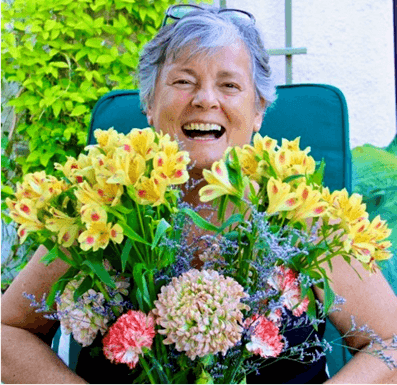
Lynn’s Story
How does a wonderful mother, grandmother, happy wife, charming hostess, gifted teacher, successful artist, and talented gardener cope when advanced Alzheimer’s takes all this away? Indeed, how does her family cope?
This is Lynn’s story.
Not so long ago, Lynn was the high functioning person described above. Progressively little hints of issues including memory and uncharacteristic behaviour were noticed. No big deal and at first laughed off as Lynn’s mild dyslexia and her age.Into Lynn’s 70s, her driving seemed to be, at first, less sure, and then progressively concerning. Professional help and testing indicated some increasing issues with cognition, but nothing immediately became problematic. As more time passed, it was clear that Lynn was slipping. Still warm, cheery, and functioning independently, but occasionally confused.
Lynn was lucky to become an outpatient at a specialty brain clinic. More testing indicated that her frontal lobe had shrunk more than would be expected at her age. She failed a driving test and lost her driver’s licence. The loss of independence was an emotional blow and foreshadowed other needs for support.
Being empty nesters, the role of caregiver increasingly fell on me. I happily took this on. Lynn was still quite functional and good company so that my caregiver role was not so demanding at first. Faster than expected, I became housekeeper, shopper, chauffeur, and dispenser of prescriptions. And Lynn began to need help with hygiene and toileting.
Lynn was still warm and responsive and enjoyed limited socializing with family and close friends. Even with part-time help at home, the burden of being principal caretaker with the level of support Lynn required was taking a toll on me as I turned 80. Family and our doctors finally convinced me that we needed to make a change.
After examining our options, the optimum solution was to find a care home with experience of Alzheimer’s and a welcoming culture. My daughter-in-law and I researched the many available care facilities around Toronto, made a short list of six, and toured all six. We found that most of the facilities were very large and offered a continuum from independent living, through increasing stages of assisted living and culminating in what was usually termed “memory care”. Typically, “memory care” meant moving residents with dementia to a controlled access floor so that wonderers couldn’t get out on their own. Staffing and other resources on these floors seemed minimal.
In some cases, one couldn’t get a straight answer to the question will my loved one be able to remain until end of life? Of course, no facility can guarantee this in the event that a resident becomes aggressive, abusive, or requires hospitalization or specialized hospice care. One suspects that a controlled access floor was viewed by some facilities as a temporary posting until the resident could be moved out altogether.
We did find two facilities that specialized in dementia care, including Alzheimer’s. They were both small with specialized resources and programs, extra staffing and the goal of providing as much stimulation mentally and physically as possible for each resident.
We were instantly attracted to the small homelike environment, nurturing culture, creative programs and caring staff at Cedarhurst. It was the answer for Lynn and for me and our family. And it has proved to be the right answer.
The arc of Alzheimer’s disease is relentless, and Lynn is slowly failing. It pains me to see her condition now, however, I will keep visiting as long as it brings her pleasure. She isn’t verbal anymore and doesn’t remember my name, but she lights up that great smile when she sees me.
I’m welcome to and do visit her frequently. And best of all, I am comforted that Lynn is well cared for in the last chapter of her story.